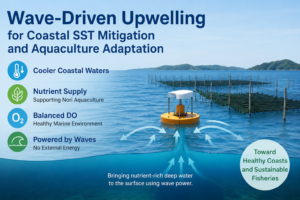
Wave-Driven Upwelling for Coastal SST Mitigation and Aquaculture Adaptation
― Potential Applications for Nori Aquaculture and Shallow Coastal Waters ―
Recent coastal environments in Japan have been increasingly affected by:
- Rising sea surface temperatures (SST)
- Marine heatwaves
- Dissolved oxygen (DO) decline
- Stratification of shallow coastal waters
- Nutrient depletion in aquaculture areas
These changes are already impacting fisheries and aquaculture production, including oyster farming, fish culture, and especially nori aquaculture.
At the same time, the issue of “nori discoloration” caused by nutrient depletion (particularly DIN reduction) has become a serious challenge in several coastal regions such as Ariake Bay.
A Nature-Based Approach Using Wave Energy
NPO ESCOT has been developing and testing a wave-driven upwelling pump, a passive system that utilizes wave motion to transport cooler and nutrient-rich lower-layer seawater toward the surface.
Unlike conventional mechanical systems, this approach:
- Requires no large external energy supply
- Utilizes natural wave energy
- Can operate continuously in coastal environments
- May support distributed and low-cost coastal adaptation strategies
This technology is inspired by natural oceanic upwelling systems, which are known to create some of the world’s most productive fishing grounds.
Importance of Balanced Vertical Mixing
Recent analysis using multi-depth observational data from central Ise Bay suggests that:
- Simply bringing colder deep water to the surface is not always optimal
- Excessively deep water may contain low dissolved oxygen (DO)
- Shallow intermediate layers (around 5 m depth) may provide a better balance between:
- Temperature reduction
- Oxygen maintenance
- Environmental stability
This indicates that balanced artificial vertical mixing may be more important than maximum cooling alone.
Potential Application to Nori Aquaculture
Wave-driven upwelling may contribute to:
- Nutrient recycling in coastal waters
- Mitigation of nori discoloration risks
- Reduction of thermal stress
- Improvement of coastal water circulation
- Climate change adaptation for aquaculture
The concept is not to artificially “control” nature, but rather to gently support the natural vertical circulation that coastal ecosystems originally possessed.
Toward Practical Coastal Climate Adaptation
Many existing studies focus on numerical simulations or large-scale engineering systems.
In contrast, ESCOT is exploring:
- Small-scale
- Passive
- Low-energy
- Field-oriented
approaches suitable for real coastal communities and fisheries.
As marine heatwaves and coastal environmental changes intensify globally, practical and decentralized adaptation technologies may become increasingly important.
Related Keywords
- Coastal SST Mitigation
- Wave-Driven Upwelling
- Artificial Vertical Mixing
- Marine Heatwave
- Dissolved Oxygen (DO)
- Aquaculture Adaptation
- Nori Aquaculture
- Nutrient Recycling
- Climate Change Adaptation
- Shallow Coastal Waters
- Nature-Based Solutions
Collaboration Invitation
NPO ESCOT is interested in collaborative research and field demonstrations related to:
- Coastal environmental improvement
- Aquaculture adaptation
- Nori cultivation support
- Low-energy coastal technologies
- Wave-driven circulation systems
We welcome collaboration opportunities with:
- Researchers
- Fisheries cooperatives
- Coastal municipalities
- Environmental organizations
- International partners
NPO ESCOT
Environmental Solutions & Climate Optimization Technologies
NPO ESCOT Official Website