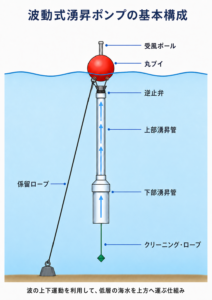
Basic Configuration of the Wave-Actuated Upwelling Pump
An Energy-Efficient Technology That Uses Wave Motion to Transport Lower-Layer Seawater Upward
The wave-actuated upwelling pump being developed by ESCOT is an energy-efficient device that uses the vertical motion of ocean waves to transport seawater from lower layers toward the upper layer.
Without relying heavily on electricity or fuel, the system utilizes natural wave energy. Potential applications include moderating high surface-water temperatures, improving aquaculture environments, and promoting local water exchange.
In recent years, high seawater temperatures have become a major concern for scallop farming and other aquaculture operations in Mutsu Bay and elsewhere in Japan.
ESCOT is therefore improving and testing this system from the perspective that continuously supplying relatively cool water from shallow lower layers to the upper layer may contribute to localized cooling and environmental improvement.
What Is a Wave-Actuated Upwelling Pump?
A wave-actuated upwelling pump is a device that uses the vertical motion generated by surface waves to draw lower-layer seawater into a pipe and transport it upward.
Its basic components are:
- Wind-catching pole
- Spherical buoy
- Check valve
- Upper upwelling pipe
- Lower upwelling pipe
- Mooring rope
- Cleaning rope
As the buoy moves up and down with the waves, relative motion is created between the pipe and the water inside it.
The check valve rectifies this reciprocating motion into a primarily upward flow, allowing lower-layer seawater to be transported toward the surface.
Illustration
Figure 1. Basic configuration of the wave-actuated upwelling pump
Conceptual illustration showing how vertical wave motion is used to transport seawater from a lower layer upward.
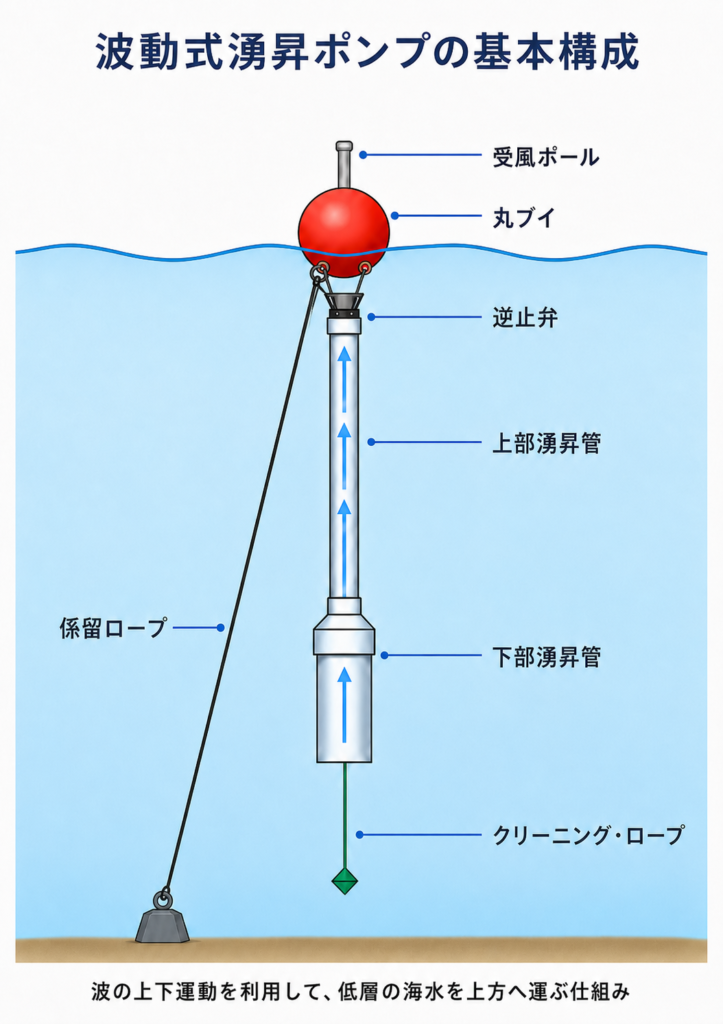
Suggested English labels for the illustration
| Japanese | English |
|---|---|
| 受風ポール | Wind-catching pole |
| 丸ブイ | Spherical buoy |
| 逆止弁 | Check valve |
| 上部湧昇管 | Upper upwelling pipe |
| 下部湧昇管 | Lower upwelling pipe |
| 係留ロープ | Mooring rope |
| クリーニング・ロープ | Cleaning rope |
Suggested English caption inside the illustration:
A system that uses vertical wave motion to transport lower-layer seawater upward.
Main Physical Principles Involved
The operation of the wave-actuated upwelling pump can be explained through a combination of several basic physical principles.
1. Buoyancy
The spherical buoy receives an upward buoyant force from the surrounding seawater and moves vertically in response to the waves.
This motion of the floating body provides the driving force for the entire system.
2. Inertia of Water
Even when the pipe moves vertically, the water inside it does not immediately move in exactly the same way. It tends to remain in its existing state of motion.
This inertia creates relative motion between the pipe and the water inside it.
3. One-Way Flow Produced by the Check Valve
Wave motion is naturally reciprocating, involving both upward and downward movement.
The check valve mechanically rectifies this oscillating motion into an upward flow, making it possible to transport lower-layer seawater upward continuously or intermittently in one primary direction.
4. Use of Wave Energy
Work is required to raise water against gravity. In this system, the energy source for that work is the motion of the waves.
The device can therefore be described as a:
Check-valve pumping system driven by wave energy
A more technically precise description is:
Positive-displacement pumping driven by wave energy
The buoy and pipe move vertically with the waves, while the check valve converts the relative motion of the pipe and the internal water column into an upward-directed flow.
Most Appropriate Technical Description
The operating principle can be described as:
Positive-displacement pumping that uses the vertical motion of a floating body and the inertia of the water column, while a check valve converts reciprocating motion into a one-way upward flow.
A shorter name would be:
Wave-driven check-valve positive-displacement pumping principle
This mechanism differs from siphoning.
When water is discharged continuously above sea level, wave energy performs the work required to overcome the gravitational head.
Physical Laws and Principles Related to the System
1. Archimedes’ Principle
The floating buoy receives a buoyant force from the seawater and follows the vertical movement of the sea surface.
This provides the driving motion of the pump.
2. Hydrostatic Pressure
Pressure increases with water depth. The pressure difference associated with a vertical height difference is expressed as:ΔP=ρgΔh
where:
- ΔP is the pressure difference,
- ρ is the density of seawater,
- g is gravitational acceleration,
- Δh is the vertical height difference.
Lifting lower-layer water to the surface or above the sea surface requires work corresponding to this hydraulic head.
3. Newton’s Laws of Motion and Fluid Inertia
When the pipe moves vertically, the water column inside it does not respond instantaneously because of inertia.
The resulting relative motion contributes to the opening and closing of the valve and to the intake and discharge of water.
4. Flow Rectification by the Check Valve
The check valve converts the reciprocating motion generated by waves into an upward-directed flow.
This is not itself a fundamental physical law, but rather a mechanical flow-rectification mechanism.
5. Bernoulli’s Principle and the Continuity Equation
Bernoulli’s principle and the continuity equation are useful when evaluating relationships among pressure, velocity and pipe cross-sectional area.
However, it would not be accurate to describe the fundamental lifting mechanism of this pump simply as a “Bernoulli effect.”
Why Use a Larger-Diameter Lower Pipe?
ESCOT is currently examining a configuration in which the lower upwelling pipe has a larger diameter than the upper upwelling pipe.
The purpose is not based on the assumption that water flows faster through a wider pipe.
For the same flow rate, the average velocity is actually lower in a larger-diameter pipe.
The relationship between flow rate, cross-sectional area and average velocity is:Q=Av
where:
- Q is the volumetric flow rate,
- A is the pipe cross-sectional area,
- v is the average flow velocity.
Nevertheless, using a larger lower pipe may provide several advantages.
1. Potentially Increasing the Volume of Water Involved in Each Cycle
A larger cross-sectional area may increase the volume of water drawn into or displaced by the system during each wave-induced movement.
The actual increase will depend on valve behavior, stroke length, wave period, hydraulic resistance and the inertia of the water column.
2. Potentially Reducing Intake Velocity
A wider intake can reduce the local intake velocity for the same flow rate.
Possible benefits include:
- Reduced entrance resistance
- Reduced vortex formation
- Less disturbance of seabed sediment
- Reduced risk of drawing in small fish, seaweed and floating debris
These effects are expected benefits and must be confirmed under actual operating conditions.
3. Combining a Large Lower Pipe with a Smaller Upper Pipe
The concept is to secure sufficient intake capacity in the lower section while guiding the flow through the narrower upper section.
This may help balance water intake volume and discharge velocity.
However, the larger lower pipe itself does not directly increase the discharge velocity. The final discharge velocity is determined mainly by the flow rate and the cross-sectional area of the upper pipe and outlet.
An Important Limitation: Losses at the Diameter-Reduction Joint
A larger lower pipe does not necessarily improve the overall pumping performance.
When water moves from the larger lower pipe into the smaller upper pipe, disturbances and hydraulic losses may occur at the reducing joint.
Possible effects include:
- Flow separation
- Vortex formation
- Local pressure losses
- Increased losses around the check valve
- Reduced pumping efficiency
The key question is therefore:
Does the increase in intake or displaced water volume produced by the larger lower pipe exceed the losses caused by the reducing joint, the check valve and pipe friction?
ESCOT plans to examine this issue through comparative testing.
A gradual reducer may reduce flow separation and local losses compared with an abrupt reduction in diameter. However, its effectiveness must also be evaluated in terms of weight, length, construction and durability.
Relationship to High-Temperature Countermeasures for Scallop Aquaculture
One of the major potential applications of this technology is the improvement of aquaculture environments affected by high seawater temperatures.
In recent years, rising water temperatures near the surface have become a serious concern in scallop-farming areas.
By transporting relatively cool seawater from a shallow lower layer upward, the wave-actuated upwelling pump may help moderate temperatures and improve water conditions near the upper layer.
Possible benefits include:
- Moderation of excessive surface-water temperatures
- Promotion of vertical mixing
- Support for localized water exchange
- Reduction of thermal stress in aquaculture areas
However, the results will depend on local conditions, including:
- Vertical water-temperature structure
- Dissolved oxygen conditions
- Wave height and wave period
- Current velocity and direction
- Installation depth
- Pump dimensions
- Position of aquaculture ropes and facilities
- Number and spacing of installed units
It is therefore necessary to identify an intake depth that provides cooler water without introducing low-oxygen water from excessively deep layers.
Future Verification and Comparative Testing
ESCOT plans to compare several pipe configurations under equivalent operating conditions:
- A pipe system with the same diameter throughout
- A larger-diameter lower pipe combined with a smaller-diameter upper pipe
- A system using a more gradual diameter-reduction section
The principal evaluation items will include:
- Pumped volume per cycle
- Pumping rate per unit time
- Estimated daily pumping volume
- Discharge velocity
- Horizontal spreading distance
- Relationship between wave height, wave period and pumping rate
- Opening and closing behavior of the check valve
- Flow disturbance around the reducing joint
- Stability of the entire device
- Resistance to clogging and ease of cleaning
- Durability under actual marine conditions
Through these tests, ESCOT aims to identify a practical design that is structurally simple, safe and suitable for use in aquaculture areas.
Using Wave Energy to Address Practical Coastal Problems
The wave-actuated upwelling pump is a simple and adaptable system that uses natural wave energy to transport lower-layer seawater upward.
Its operating principles are based primarily on:
- Buoyancy
- Fluid inertia
- Mechanical rectification by a check valve
- Wave energy
- Positive-displacement pumping action
Using a larger-diameter lower pipe may improve intake capacity and reduce local intake velocity. At the same time, its benefits must be evaluated against losses occurring at the reducing joint, check valve and other parts of the system.
Future comparative experiments will be used to determine a more practical configuration.
ESCOT will continue developing and communicating this technology with the objectives of:
- Adapting coastal areas to rising seawater temperatures
- Improving aquaculture environments
- Supporting the practical implementation of marine environmental technologies
Summary
This technology uses wave energy to transport lower-layer seawater upward, with the aim of helping moderate high temperatures near the sea surface.
Potential Applications
- Improvement of aquaculture environments for scallops and other species
- Moderation of high surface-water temperatures
- Support for local seawater exchange
- Promotion of vertical mixing
- Energy-efficient improvement of coastal water environments
Planned Briefing and Site Visit
ESCOT is scheduled to explain this technology to representatives from Hiranai Town, Aomori Prefecture, on August 6, 2026. The meeting is planned to be held in a conference room provided by the Iwawada Fisheries Cooperative Association in Onjuku Town, Chiba Prefecture.
Contact
ESCOT welcomes comments, technical questions and proposals for cooperation in field demonstrations of the wave-actuated upwelling pump.