波動式湧昇ポンプにおける加速度と湧昇効率の関係/Relationship Between Vertical Acceleration and Upwelling Efficiency in a Wave-Driven Upwelling Pump
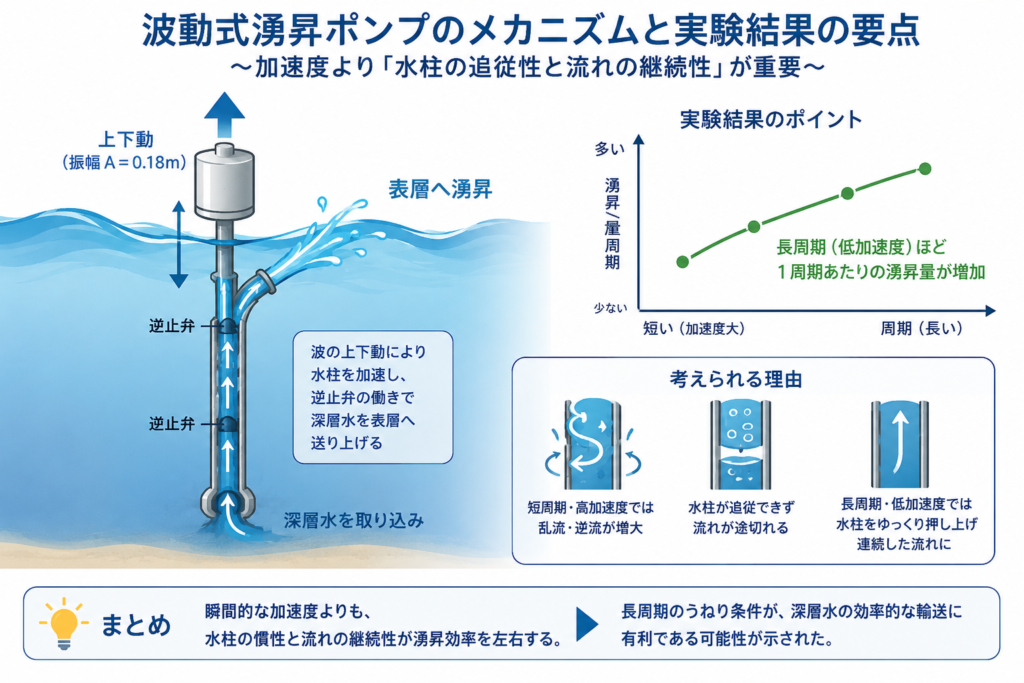
NPO法人エスコットでは現在、波浪エネルギーを利用した「波動式湧昇ポンプ」の研究を進めています。
今回、上下動条件を変化させた簡易試験を行い、
「上下加速度」と「湧昇量」の関係
について解析を行いました。
実験概要
今回の試験では、
・振幅:0.18m(固定)
・上下動周期を変更
・60秒間の湧昇量を計測
という条件で比較を行いました。
結果として、
- 短周期(高加速度)
- 長周期(低加速度)
で湧昇性能に大きな違いが見られました。
実験結果
今回の試験では、周期が長くなるにつれ、
「1周期当たりの湧昇量」
が増加する傾向が確認されました。
特に重要なのは、
「上下加速度が大きいほど湧昇量が増える」
という単純な結果にはならなかった点です。
むしろ、
・高加速度
・短周期
条件では、水柱が十分追従できず、
「水が押し切れない」
現象が発生している可能性が示唆されました。
一方、
・低加速度
・長周期
では、水柱全体を比較的ゆっくり押し上げることで、
より大きな湧昇量
が得られる結果となりました。
加速度との関係
上下動の最大加速度は以下で表されます。
a = A(2π/T)^2
(A:振幅、T:周期)
今回の試験では振幅一定のため、
周期が短いほど加速度が急増します。
しかし実際には、
「加速度が大きい=高効率」
とはならず、
むしろ長周期側で効率向上が確認されました。
| 周期 T(s) | 加速度係数 (1/T^2) | 湧昇量/周期 |
|---|---|---|
| 1.88 | 0.283 | 0.35 |
| 2.31 | 0.187 | 0.52 |
| 3.33 | 0.090 | 0.79 |
| 3.75 | 0.071 | 0.93 |
考えられる理由
今回の結果からは、波動式湧昇ポンプでは、
「瞬間的な力」
よりも、
「水柱全体の慣性と流れの継続性」
が重要である可能性が見えてきます。
特に、
・急激な上下動
・短周期振動
では、
- 配管内乱流
- 逆流
- 水柱分離
- 流れの途切れ
などが発生しやすく、
結果として正味湧昇量が低下している可能性があります。
海洋実装への示唆
この結果は実海域への応用を考える上でも興味深いものです。
海洋では、
- 短周期の風波
- 長周期のうねり
が混在しています。
今回の試験結果は、
「長周期うねりの方が、深層水輸送には有利となる可能性」
を示唆しています。
これは、
- 海洋冷却
- 漁場環境改善
- 表層高温対策
- 海洋熱波対策
などへの応用を考える上でも重要な知見となる可能性があります。
今後は、
- 実海域条件
- 水深条件
- 配管径
- 空気混入条件
- 流速分布
なども含め、さらに検証を進めていく予定です。
NPO法人エスコット
https://npo-escot.org/
English Version
Relationship Between Vertical Acceleration and Upwelling Efficiency in a Wave-Driven Upwelling Pump
NPO ESCOT is currently conducting research on a wave-driven upwelling pump that utilizes wave energy to transport deeper water toward the surface.
In a recent experiment, we analyzed the relationship between:
- vertical oscillation acceleration
- and upwelling efficiency.
Experimental Overview
The experiment was conducted under the following conditions:
- Oscillation amplitude: 0.18 m (constant)
- Oscillation period varied
- Upwelling volume measured over 60 seconds
The results showed significant differences in upwelling performance depending on oscillation period and acceleration conditions.
Experimental Results
As the oscillation period became longer, the:
“upwelling volume per cycle”
increased noticeably.
One of the most important findings was that:
“larger acceleration did not necessarily produce higher upwelling efficiency.”
Instead, under:
- short-period
- high-acceleration
conditions, the water column appeared unable to fully follow the rapid motion.
This suggests that the water mass itself could not be effectively displaced upward under excessive acceleration conditions.
Conversely, under:
- longer-period
- lower-acceleration
conditions, the system produced larger upwelling volume by pushing the water column upward more continuously and smoothly.
| 周期 T(s) | 加速度係数 (1/T^2) | 湧昇量/周期 |
|---|---|---|
| 1.88 | 0.283 | 0.35 |
| 2.31 | 0.187 | 0.52 |
| 3.33 | 0.090 | 0.79 |
| 3.75 | 0.071 | 0.93 |
Relationship with Acceleration
The maximum vertical acceleration can be expressed as:
a = A(2π/T)^2
where:
- A = oscillation amplitude
- T = oscillation period
Since the amplitude was fixed in this experiment, shorter periods produced significantly higher acceleration.
However, the experimental results indicated that:
“higher acceleration did not correspond to higher efficiency.”
Instead, efficiency improved under longer-period oscillations.
Possible Mechanism
These results suggest that, in wave-driven upwelling systems:
“water-column inertia and flow continuity”
may be more important than instantaneous acceleration force.
Under rapid oscillation conditions, the following effects may become more significant:
- internal turbulence
- reverse flow
- flow separation
- discontinuity of the water column
These losses may reduce net upwelling efficiency.
Implications for Ocean Applications
This finding may also have important implications for real ocean environments.
Ocean wave fields contain both:
- short-period wind waves
- long-period swells
The present results suggest that:
“long-period swell conditions may be more favorable for deep-water transport.”
This could become important for future applications such as:
- coastal cooling
- mitigation of marine heatwaves
- aquaculture environmental improvement
- surface temperature control
- climate adaptation technologies
Further studies are planned, including evaluation of:
- real sea conditions
- water depth effects
- pipe diameter
- air entrainment
- flow velocity distribution
NPO ESCOT
https://npo-escot.org/