ESCOT Presented a Wave-Actuated Upwelling Pump Concept at GHRSST27 in Sapporo
NPO ESCOT participated in GHRSST27 — The 27th International SST Users’ Symposium and GHRSST Science Team Meeting, held from 22 to 26 June 2026 at Hokkaido University in Sapporo, Japan.
GHRSST is an international conference focusing on sea surface temperature, or SST, and is attended by meteorological agencies, space agencies, ocean researchers, and users of satellite-based SST data. This year’s meeting was held mainly at the Institute of Low Temperature Science, Hokkaido University.
Presentation Theme
At the conference, ESCOT presented a poster based on its wave-actuated upwelling pump concept.
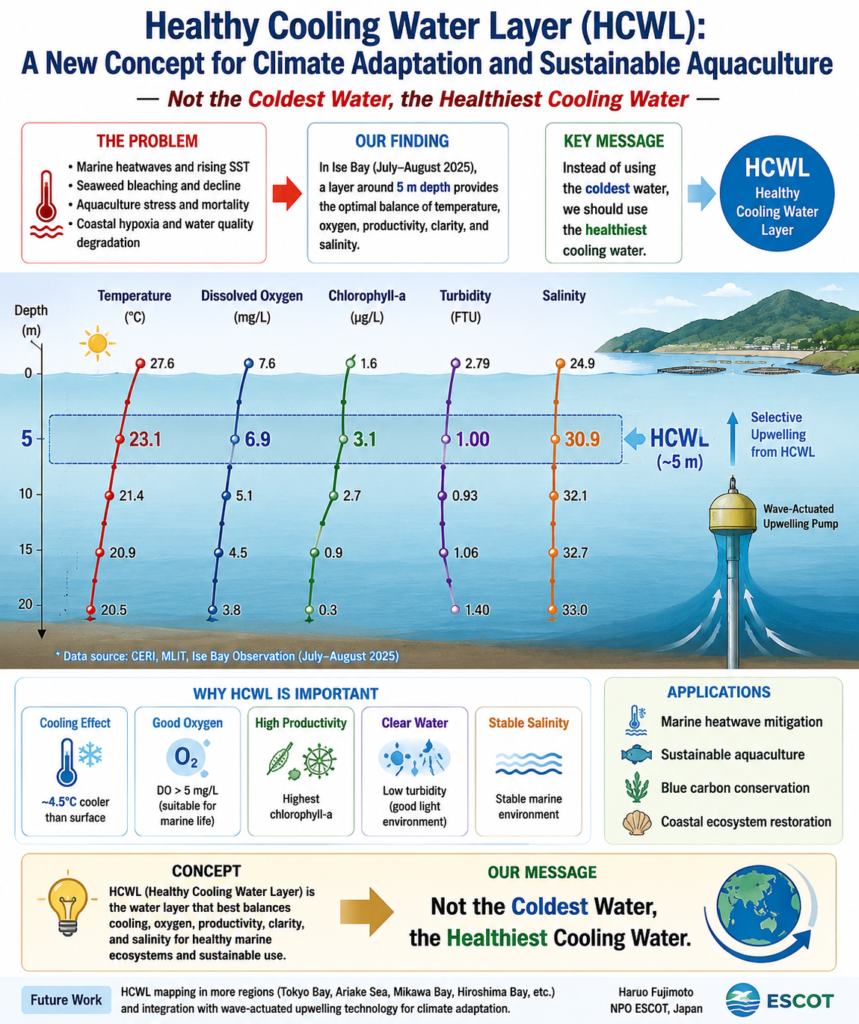
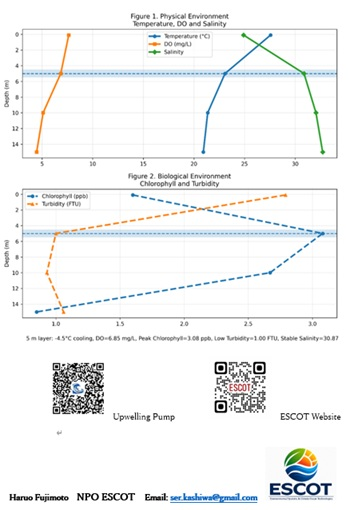
The poster analyzed vertical water-quality data from Ise Bay, including water temperature, dissolved oxygen, chlorophyll, turbidity, and salinity. Based on this analysis, ESCOT proposed the concept of a:
Healthy Cooling Water Layer, or HCWL
HCWL refers to a water layer that can contribute to cooling the sea surface while maintaining relatively healthy environmental conditions, especially in terms of dissolved oxygen.
Artificial upwelling is often associated with pumping colder water from greater depths. However, the analysis of Ise Bay data suggested that relatively shallow water, around 5 meters deep, may also be effective for surface cooling while maintaining better dissolved oxygen conditions than deeper layers.
This perspective may be important for reducing high-temperature risks in aquaculture and for developing practical climate adaptation measures in coastal waters.
Responses at the Poster Session
During the poster session, ESCOT had detailed discussions with four participants within the 30-minute explanation period.
In particular, an aquaculture-related participant from Chile showed strong interest in the wave-actuated upwelling pump and the HCWL concept, and indicated that further contact may follow. Chile is one of the world’s important aquaculture countries, especially in salmon farming, and adaptation to high water temperatures and marine environmental changes is a major issue.
ESCOT also received questions from Ms. Pallavi Govekar of the Australian Bureau of Meteorology, who asked for a detailed explanation of the presentation. Her interest in connecting SST data analysis with practical coastal environmental measures was one of the meaningful outcomes of this presentation.
In addition, ESCOT had opportunities to explain the Ise Bay analysis, the potential for sea surface temperature cooling by artificial upwelling, and possible applications to aquaculture risk reduction to researchers from Beijing and Japan’s JAXA-related research community.
Wave-Actuated Upwelling Pump
A Zero-Energy Approach to Coastal SST Cooling and Marine Heatwave Adaptation
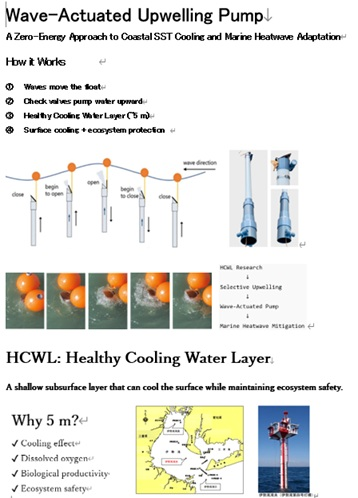
At GHRSST27 in Sapporo, NPO ESCOT distributed a short flyer introducing its wave-actuated upwelling pump and the concept of a Healthy Cooling Water Layer, or HCWL.
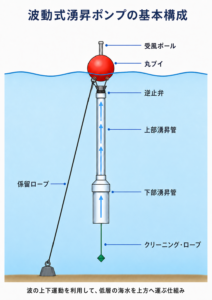
The flyer explains how wave motion can be used to lift cooler subsurface water toward the sea surface without electricity or fuel. The basic mechanism is simple:
- Waves move the float up and down.
- Check valves allow water to be pumped upward.
- Cooler water from a selected subsurface layer is brought toward the surface.
- This may contribute to surface cooling while helping to protect the coastal ecosystem.
HCWL: Healthy Cooling Water Layer
ESCOT proposes the concept of HCWL, meaning Healthy Cooling Water Layer.
HCWL is a shallow subsurface water layer that can cool the sea surface while maintaining relatively healthy environmental conditions. In other words, the purpose of artificial upwelling should not be only to bring up the coldest water, but to bring up the most suitable cooling water for both temperature reduction and ecosystem safety.
Why Around 5 Meters?
Based on the Ise Bay analysis presented at GHRSST27, the water layer around 5 meters depth appeared to have a good balance of several important factors:
- Cooling effect
- Dissolved oxygen
- Biological productivity
- Low turbidity
- Stable salinity
- Ecosystem safety
This is why ESCOT describes the 5 m layer as a possible Healthy Cooling Water Layer under the observed conditions in Ise Bay.
The key message is:
Not the coldest water, but the healthiest cooling water.
Toward Practical Coastal Adaptation
Marine heatwaves and rising sea surface temperatures are becoming serious risks for coastal waters, aquaculture areas, coral reefs, and semi-enclosed bays.
ESCOT’s wave-actuated upwelling pump is intended as a small-scale, low-energy, and field-oriented adaptation technology. By combining local water quality data, satellite SST observation, and selective artificial upwelling, this approach may help reduce high-temperature stress in coastal environments.
Further field verification is necessary, but the flyer presented at GHRSST27 summarizes ESCOT’s basic proposal:
Selective upwelling from a Healthy Cooling Water Layer may offer a practical method for coastal SST mitigation and aquaculture risk reduction.
Possible Collaboration with NASA’s High-Resolution SST Observation
At the venue, a NASA-related poster presentation introduced the use of ultra-high-resolution SST data around coral reef areas in Hawaii.
The presentation showed the potential of NASA/JPL’s MUR SST — Multi-scale Ultra-high Resolution Sea Surface Temperature data to identify fine-scale high-temperature areas and thermal stress around coastal zones, islands, and coral reefs, which are difficult to capture with coarser SST data.
This approach appears highly compatible with ESCOT’s HCWL concept and wave-actuated upwelling pump.
NASA’s high-resolution SST analysis can help identify where the sea surface is overheating and where marine heatwave or coral bleaching risks may be occurring. In contrast, ESCOT’s HCWL concept and wave-actuated upwelling pump focus on which depth of water can be safely used to cool the heated surface layer without causing oxygen depletion or environmental deterioration.
By combining these approaches, a new model may be possible:
Identify high-risk coastal areas using high-resolution SST data, select a safe cooling water layer based on HCWL evaluation, and use a wave-actuated upwelling pump to attempt localized sea surface temperature reduction.
This type of integrated approach could be particularly relevant for coral reefs, coastal aquaculture areas, semi-enclosed bays, and coastal zones exposed to high-temperature stress.
Outcomes and Future Direction
Through participation in GHRSST27, ESCOT confirmed that its concept of a small-scale, low-energy, field-oriented wave-actuated upwelling pump can attract interest even in an international SST research community.
The presentation was meaningful because it connected several important themes:
- Practical countermeasures against rising sea surface temperatures
- High-temperature risk reduction in aquaculture
- Climate change adaptation in coastal waters
- Low-energy artificial upwelling technology
- Integration of satellite SST data and field-based environmental measures
Further verification will be necessary, including additional field data collection, device improvement, and quantitative evaluation of cooling effects. Nevertheless, this presentation provided ESCOT with a valuable opportunity to introduce its activities to researchers and practitioners in Japan and overseas.
ESCOT will continue to develop the wave-actuated upwelling pump, refine the HCWL concept, and explore its potential application to coastal aquaculture and marine heat stress mitigation.
Haruo Fujimoto
NPO ESCOT