Major Artificial Upwelling Experiments Conducted Worldwide
The following is a summary of major artificial upwelling experiments and demonstration projects that have been conducted around the world. In conclusion, artificial upwelling has been tested in various regions, but there is still no clear large-scale demonstration proving effective CO₂ removal. The most reliable results so far are related to fishery enhancement, aquaculture improvement, primary production increase, cooling, and nutrient supply.
1. HOYO Experiment, Sea of Japan, around 1989–1990
The HOYO experiment was one of Japan’s early offshore artificial upwelling trials. According to later reviews, Ouchi and colleagues conducted an offshore experiment around 1989–1990. They succeeded in lifting nutrient-rich deep seawater from approximately 220 m depth.
However, the upwelled water was denser than the surrounding surface water. As a result, it quickly sank below the euphotic zone, where sunlight is available for photosynthesis.
Significance
This experiment showed that even if deep water can be lifted mechanically, it may not remain in the surface layer. If the upwelled water is too dense, it may not directly contribute to phytoplankton production or sea surface temperature cooling.
2. TAKUMI / Sagami Bay, Japan, from 2003
TAKUMI is one of Japan’s best-known artificial upwelling systems. The Ocean Nutrient Enhancer “TAKUMI” was installed in Sagami Bay and began operation in May 2003.
It reportedly lifted approximately 100,000 m³ of deep seawater per day from around 200 m depth. Some reports describe it as one of the world’s first successful examples of artificial upwelling that increased primary production in a real marine environment.
Later reviews note that the system brought deep seawater from around 200 m depth up to approximately 20 m depth. Increases in pico-phytoplankton and nano-phytoplankton were observed. However, carbon flux was not measured, and the system required substantial construction, electricity, and maintenance costs.
Difference from the ESCOT concept
TAKUMI is a large-scale, electricity-dependent system designed to supply deep-water nutrients to the euphotic zone. By contrast, the ESCOT wave-actuated upwelling pump is a small-scale, wave-powered system that aims to lift relatively shallow cool water from about 3–6 m depth to the surface.
Its primary purpose is not nutrient enrichment by deep water, but sea surface temperature cooling and reduction of aquaculture risk.
3. Stommel-type Perpetual Salt Fountain, Mariana Region, early 2000s
A Japanese research group, including researchers from Tohoku University, examined artificial upwelling based on Stommel’s “perpetual salt fountain” principle.
In the Mariana region, they used a flexible PVC pipe approximately 0.3 m in diameter and 280 m long. Based on numerical analysis and measurements, they estimated an upward flow velocity equivalent to about 212 m per day.
Significance
This approach attempts to use temperature and salinity differences, rather than external energy, to lift deep seawater. However, practical application faces major challenges, including the durability of long pipes, wave resistance, installation, and maintenance.
4. Lysefjord, Norway, 2004–2005
A large-scale artificial upwelling experiment was carried out in Lysefjord, western Norway, with aquaculture and shellfish production in mind.
Using an air-lift system, nutrient-rich deep water was supplied to the upper layer. Reports indicate that a chlorophyll-a increase of about threefold was observed in a plume covering approximately 10 km².
Other summaries describe the system as using air supplied through a diffuser pipe installed at around 40 m depth. Deep water was lifted to the upper 17 m, and an increase in non-toxic algae was observed.
Significance
This is a practical example of artificial upwelling aimed at increasing natural food supply around aquaculture areas.
5. Atmocean Wave-Powered Pump Experiment, off Hawaii, 2008
This offshore experiment was conducted near Station ALOHA, north of Oahu, Hawaii.
The researchers used a commercial wave-powered pump developed by Atmocean. The purpose was to test deployment, durability, and the feasibility of supplying deep water in the open ocean.
Sensors recorded the delivery of deep, cold water to the surface layer for approximately 17 hours. However, the pump materials later failed.
Significance
This is one of the representative offshore wave-powered artificial upwelling experiments. It showed that wave-powered upwelling is possible in principle, but also highlighted the serious durability challenges of operating in the open ocean.
6. Omura Bay, Nagasaki, Japan, 2011–2012
A practical artificial upwelling trial was conducted in Omura Bay, Nagasaki Prefecture, in a semi-enclosed coastal bay used for oyster aquaculture.
Artificial upwelling was induced by bottom aeration. The experiment reportedly produced a local summer water temperature reduction of about 1°C, redistribution of nutrients, and an increase in diatoms.
However, when the scale of the upwelling was not large enough to overcome hypoxia and high-temperature conditions, improvement in oyster condition was limited.
Relationship to the ESCOT concept
This case is highly relevant to the ESCOT approach because its purpose was not offshore CO₂ removal, but rather improvement of water temperature, dissolved oxygen, and food availability in an aquaculture area.
7. Aoshan Bay, Shandong Province, China, around 2017–2020
A team from Zhejiang University conducted China’s first artificial upwelling demonstration project in Aoshan Bay, Shandong Province.
The project combined air-lift artificial upwelling, marine renewable energy supply, environmental and carbon-sink monitoring, and large seaweed cultivation.
According to Zhejiang University, the project area covered more than 30 hectares. Due to tidal effects, surface nutrient concentrations were expected to increase over at least 300 hectares. The system reportedly operated safely for 20 months while experiencing three typhoons and one tropical depression.
Related studies examined kelp cultivation in Aoshan Bay and suggested that artificial upwelling could contribute to seaweed growth, nutrient removal, and coastal blue carbon.
Significance
This is one of the most implementation-oriented artificial upwelling projects in recent years. It is notable for combining solar power, wind power, air-lift upwelling, seaweed cultivation, and carbon-sink monitoring.
8. KOSMOS / Gran Canaria, Canary Islands, 2018 and 2019
The KOSMOS experiments were conducted near Gran Canaria as part of the Ocean artUp project led by GEOMAR and other institutions.
These were mesocosm experiments, meaning that large enclosed water columns were used to simulate artificial upwelling. In the 2018 experiment, nine KOSMOS units were deployed in Gando Bay. Deep water was added to enclosed water bodies of about 44 m³ each, and the effects of single addition, repeated addition, and different nutrient input levels were compared.
The results showed that high-intensity and repeated additions tended to enhance biological production. However, the experiments also showed that carbon fixation, food-web transfer, sinking, and remineralization must be carefully evaluated. It cannot simply be assumed that “adding nutrients leads to CO₂ removal.”
Significance
These experiments are very useful for studying ecosystem responses in detail. However, they are not continuous open-ocean pumping experiments. Rather, they are controlled simulations in which deep water is added to enclosed experimental systems.
9. Wave-Powered Pump Sea Trials South of the Canary Islands, recent years
GEOMAR has also conducted offshore experiments south of the Canary Islands using wave-driven pumps.
The system uses only wave energy to lift nutrient-rich water from around 200 m depth into the euphotic zone. The goal is to study biological responses and the possibility of enhancing ocean CO₂ uptake through artificial upwelling.
Significance
Like the Atmocean experiment in Hawaii, this is a field trial of wave-powered artificial upwelling. However, it remains at the stage of technical demonstration and ecological impact assessment. Its effectiveness as a climate mitigation method has not yet been established.
10. ESCOT Wave-Actuated Upwelling Pump, Japan, from around 2019
The ESCOT approach is quite distinctive among global artificial upwelling studies.
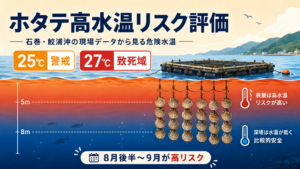
Many artificial upwelling projects aim to lift deep water from around 200 m depth to supply nutrients and enhance CO₂ uptake. By contrast, the ESCOT wave-actuated upwelling pump aims to lift relatively shallow cool water from around 3–6 m depth to the surface in order to suppress sea surface temperature rise.
ESCOT describes the device as a system that uses only wave motion to bring lower-temperature subsurface water upward and cool the surface layer.
This concept fits well with the findings from the Ise Bay data analysis, which showed that water around 5 m depth can be cooler than the surface while still maintaining relatively acceptable dissolved oxygen levels.
The ESCOT concept can therefore be positioned as a form of shallow artificial upwelling that avoids bringing up low-oxygen deep water.
Summary: Key Lessons from Global Artificial Upwelling Experiments
Artificial upwelling experiments can be divided into three major categories.
1. Offshore deep-water upwelling
Examples include HOYO, TAKUMI, Atmocean, and the Canary Islands wave-pump trials.
These systems aim to bring nutrient-rich deep water to the surface to enhance primary production and possibly CO₂ uptake. However, they face several challenges:
- Deep water is often too dense and may sink again.
- Offshore equipment is vulnerable to wave damage.
- Construction, power, and maintenance costs can be high.
- Carbon sequestration effects remain uncertain.
2. Coastal and aquaculture-oriented artificial upwelling
Examples include Lysefjord in Norway, Omura Bay in Japan, and Aoshan Bay in China.
These projects are more directly linked to practical uses such as aquaculture support, seaweed cultivation, water-quality improvement, and enhancement of natural food supply. This direction appears more realistic and immediately applicable than large-scale offshore CO₂ removal.
3. Mesocosm-based research
The KOSMOS experiments near Gran Canaria are representative examples.
These experiments are valuable for understanding plankton responses, carbon cycling, food-web effects, and ecological risks. However, they are not the same as continuous real-sea upwelling systems.
Suggested Positioning of the ESCOT Concept for GHRSST27
The following message would be strong for presenting the ESCOT concept:
Conventional artificial upwelling has mainly focused on bringing deep, nutrient-rich water to the surface. However, deep-water upwelling involves risks such as low dissolved oxygen, high density, high cost, and ecological disturbance.
The Ise Bay analysis suggests that relatively shallow cool water around 5 m depth may be sufficient to reduce sea surface temperature while avoiding serious dissolved oxygen risk.
Therefore, in coastal waters, aquaculture areas, and semi-enclosed bays, shallow artificial upwelling based on a “Safe Cooling Depth” may be more practical than conventional deep-water upwelling.
This framing makes the ESCOT wave-actuated upwelling pump clearly distinct from earlier artificial upwelling approaches worldwide.