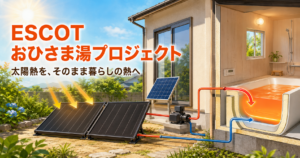
Direct Solar Thermal Use and Bathtub Heat Storage Project
Turning Solar Energy Directly into Useful Heat for Daily Life
Japanese version is available here.
Solar energy does not always need to be converted into electricity before it can be used. When the final requirement is hot water or low-temperature heat, capturing solar energy directly as heat can provide a simple and practical solution.
NPO ESCOT is developing and testing a lightweight solar thermal system that combines solar collectors, a small photovoltaic-powered circulation pump, a stainless-steel heat exchanger, and an existing insulated bathtub that also serves as a temporary thermal storage tank.
Solar Thermal Energy Is Growing Worldwide but Declining in Japan
Solar thermal energy is not an obsolete technology.
The International Energy Agency projects that solar thermal heat consumption in buildings will increase by nearly 40% worldwide between 2023 and 2028. Solar thermal systems are expected to continue playing an important role in decarbonising water and space heating.
Source: IEA, Renewables 2023 – Heat
In Japan, however, the number of homes using solar water-heating equipment has decreased.
According to the 2025 Solar System Data Book published by the Solar System Development Association, approximately 3.09 million Japanese homes had solar water-heating equipment in 2003. By 2023, this had fallen to approximately 1.69 million homes. The share of all homes using these systems declined from 6.59% to 3.04%.
Source: Solar System Development Association, 2025 Solar System Data Book
Several factors may have contributed to this decline:
- Negative impressions created by aggressive door-to-door sales in the past
- The image of older systems with heavy water tanks mounted on roofs
- A decline in the number of qualified installers
- Policies and public attention concentrating heavily on solar photovoltaics
- Limited awareness of modern pumped and separated-storage systems
Modern solar thermal systems do not necessarily require a heavy tank on the roof. Solar collectors can be separated from the storage tank, and small circulation pumps and simple temperature-control methods can be used.
Solar thermal technology should therefore not be judged only by the design of older rooftop water heaters.
A Climate Solution Missing from Japan’s Summer Heat Debate
On 26 July 2026, the Japanese national broadcaster NHK aired a television discussion about extreme summer temperatures exceeding 40°C and the actions required to protect health, homes and workplaces.
Measures such as preventing heatstroke, using air conditioning appropriately, improving building insulation and changing working practices are essential. These are climate adaptation measures that help protect people from heat that is already occurring.
However, the programme said little about mitigation measures that address the cause of continuing climate change—particularly the direct use of solar heat.
Adapting to extreme heat is necessary, but society must simultaneously reduce fossil-fuel consumption and greenhouse-gas emissions to limit further warming.
Renewable Energy Is Not Only Electricity
In Japan, the term “renewable energy” often brings solar photovoltaics and wind power to mind.
However, electricity is not the only form of energy required by homes, businesses and public facilities. Large amounts of thermal energy are used for:
- Domestic hot water
- Bathing and showers
- Space heating
- Cooking
- Drying
- Washing and cleaning
- Agricultural and industrial processes
Much of this heat is currently produced using gas, oil or electricity.
A solar thermal collector captures the sun’s energy directly as heat and transfers it to water or another circulating fluid. Japan’s Agency for Natural Resources and Energy formally recognises solar thermal utilization as a form of renewable energy.
If Hot Water Is Needed, Use the Sun’s Heat Directly
Solar photovoltaics and solar thermal systems should not be regarded as competing technologies. Each produces a different and useful form of energy.
Where electricity is required, photovoltaic generation is valuable. Where hot water or low-temperature heat is required, direct solar thermal collection can be a rational solution.
A photovoltaic water-heating route generally follows this process:
Solar energy
→ Electricity
→ Electric water heater or heat pump
→ Hot water
A solar thermal system uses a more direct route:
Solar energy
→ Collected heat
→ Hot water
A simple comparison of efficiency is not always appropriate because electricity and heat have different qualities and uses. Nevertheless, when the final requirement is hot water, directly capturing solar heat has significant practical value.
Solar thermal systems can also operate alongside photovoltaic panels instead of replacing them.
Solar Water Heating as Climate Mitigation
A solar water heater does not directly lower the global temperature. The collected heat eventually returns to the surrounding environment after use.
Its main environmental value is that solar-heated water can reduce the amount of gas, heating oil or electricity required for water heating.
The process is:
Solar heat replaces part of the fossil-fuel or electrical heating demand
↓
Energy consumption and CO₂ emissions are reduced
↓
The system contributes to limiting future global warming
The Tokyo Metropolitan Government estimates that household solar thermal utilization may reduce annual energy costs by approximately JPY 25,000–29,000 and annual CO₂ emissions by approximately 0.4–0.6 tonnes per household.
Actual results depend on location, solar radiation, hot-water consumption, system configuration and the energy source being replaced.
Source: Tokyo Metropolitan Government – Solar Thermal Energy
Combining Solar Thermal Energy with Photovoltaics and Heat Pumps
A solar thermal system does not need to supply all household hot water throughout the year.
Solar heat can preheat water during sunny periods. If the temperature is insufficient, an existing gas water heater, oil boiler, electric heater or heat pump can provide only the remaining heat.
For example:
- Solar energy raises the water temperature from 15°C to 40°C.
- The existing heater supplies only the additional heat needed to reach the desired temperature.
Even when solar energy does not provide the full heating load, preheating can substantially reduce the work required from conventional equipment.
The practical approach is therefore not:
Solar PV or solar thermal
Heat pump or solar thermal
Instead, it can be:
Produce electricity with photovoltaics
+
Produce hot water with solar thermal collectors
+
Use a heat pump or existing heater only for the shortfall
Why Solar Thermal Energy Is Particularly Relevant During Japan’s Humid Summers
Bathing and showering remain necessary during Japan’s hot and humid summers. During extreme heat, increased perspiration can make bathing and showering even more important.
Summer is also the season when the greatest amount of solar heat is available.
Despite this, many households continue to use gas, oil or electricity to produce hot water even on extremely sunny days.
Fossil-fuel use results in CO₂ emissions, while water heaters and power-generation facilities also release waste heat. The direct warming effect of this waste heat is much smaller than the long-term effect of greenhouse gases. Nevertheless, when abundant solar heat is already available, it is reasonable to question whether additional energy should always be consumed to create the same heat.
ESCOT’s Design Philosophy
NPO ESCOT does not focus solely on producing equipment with the highest catalogue performance.
Our objective is to develop solar thermal systems that are understandable, repairable, adaptable and usable over a long period.
The main principles are:
- Use solar energy directly as heat and minimise unnecessary energy conversion.
- Avoid unnecessarily complicated equipment.
- Operate the circulation pump with a small photovoltaic panel.
- Consider installation on walls, in gardens, on balconies and on carports—not only on roofs.
- Reduce weight so that collectors can be moved or repositioned.
- Allow operation without grid electricity.
- Use replaceable and commercially available components wherever possible.
- Avoid excessive dependence on microprocessor-based control systems.
- Enable DIY assembly, installation and repair where safely possible.
- Consider using reliable commercially manufactured collectors for the most technically demanding component.
- Use an existing insulated bathtub as a same-day heat storage tank.
Climate action does not always require large and expensive facilities. Technologies assembled from understandable and accessible components can also reduce fossil-fuel consumption at household and community level.
ESCOT’s Current Bathtub-Heating Solar Thermal System
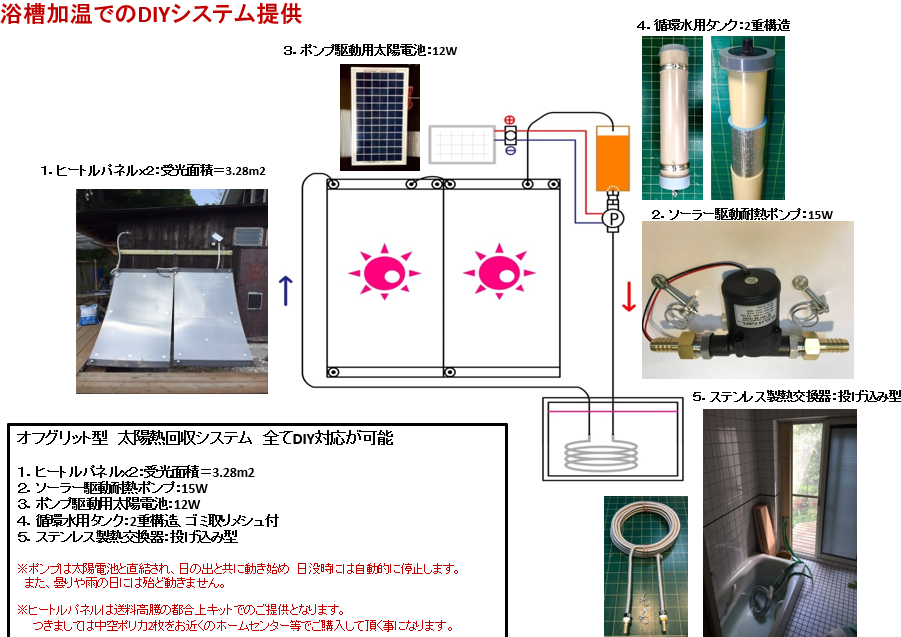
Figure 1. Basic configuration of ESCOT’s current solar thermal bathtub-heating system
The present experimental system consists mainly of the following components:
| Component | Function |
|---|---|
| Two Heatle Panels | Absorb solar heat and transfer it to the circulating fluid |
| Small photovoltaic panel | Supplies electricity to the circulation pump |
| Solar-powered high-temperature circulation pump | Moves the fluid between the collectors and heat exchanger |
| Small circulation-fluid reservoir | Helps regulate the fluid and remove trapped air |
| Weather-resistant water hose | Provides durable outdoor circulation piping |
| Immersed stainless-steel heat exchanger | Transfers heat from the circulation loop to the bathwater |
| Insulated bathtub and insulated cover | Store the heated water and act as a thermal storage tank |
| Existing water heater | Provides supplementary heating when solar energy is insufficient |
In the illustrated configuration, the two Heatle Panels have a total solar-receiving area of approximately 3.28 m².
The circulation pump is rated at approximately 10–15 watts and is powered by a photovoltaic panel of approximately 12 watts.
Separating Bathwater from the Collector Loop
ESCOT’s current system does not circulate bathwater directly through the solar collectors.
Instead, a separate fluid circulates between the collectors and a stainless-steel heat exchanger immersed in the bathtub.
The heat-transfer process is:
Solar energy
↓
Heatle Panel
↓
Heated circulation fluid
↓
Stainless-steel heat exchanger
↓
Bathwater
This arrangement separates the outdoor collector circuit from the water used for bathing. Water inside the panels and outdoor hoses does not need to mix directly with the bathwater.
Using the Bathtub Itself as a Thermal Storage Tank
Conventional solar hot-water systems often require a dedicated storage tank. However, when solar heat is used specifically for same-day bathing, a modern insulated bathtub can serve as temporary thermal storage.
Solar heat is collected during the day and transferred to the bathtub. The stored warm water can then be used in the evening.
This approach may reduce the need for:
- A large dedicated storage tank
- Additional installation space
- Heavy rooftop equipment
- Complicated plumbing
- Tank maintenance
If solar energy alone does not raise the water to the required temperature, the existing water heater or reheating function can provide only the remaining heat.
The objective is not necessarily to meet the entire demand with solar energy. It is to maximize solar preheating and reduce the use of gas, oil and electricity.
The bathwater is treated separately from drinking and kitchen hot water and is intended for use on the same day.
Lightweight Heatle Panels with Internal Flow Channels
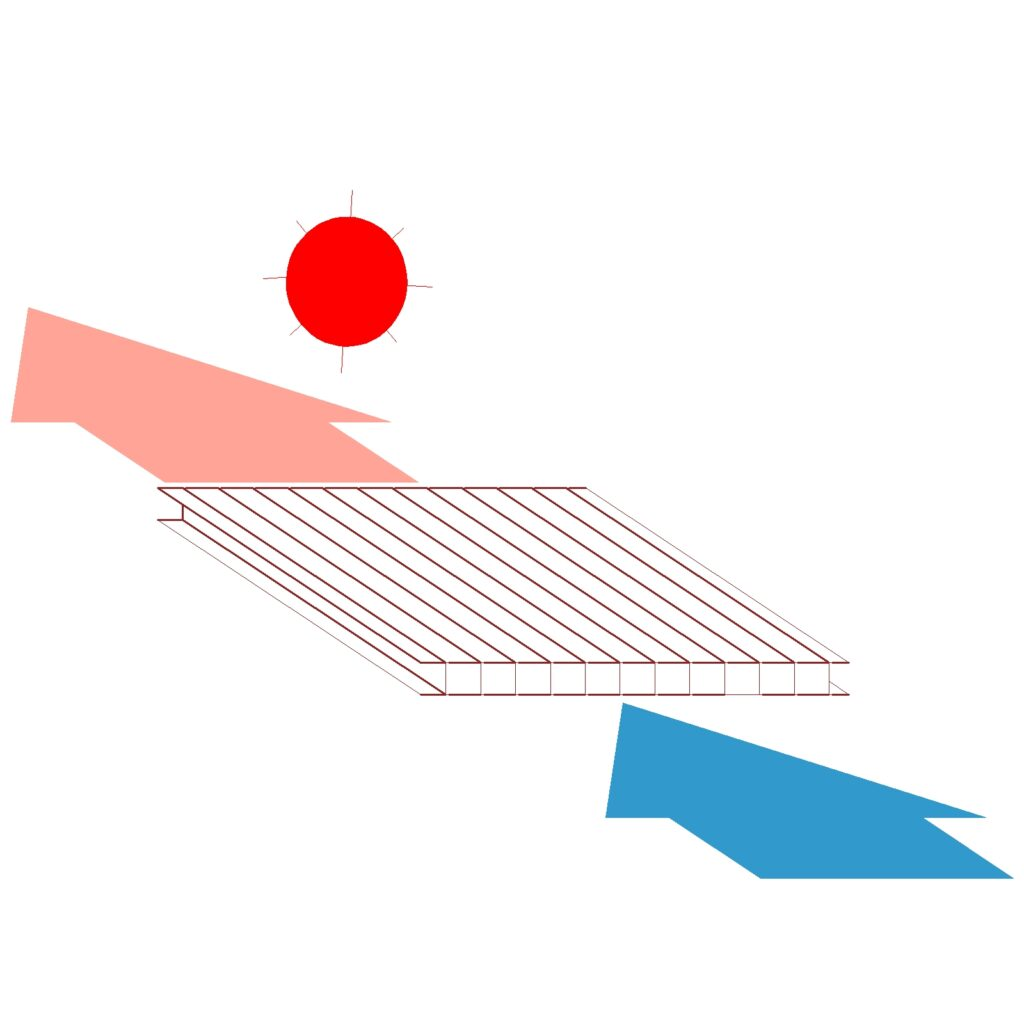
Figure 2. Water flows through multiple internal channels in the panel and collects solar heat
ESCOT’s Heatle Panel uses a lightweight hollow structure, such as multi-wall polycarbonate sheet, with numerous narrow internal channels. Water passes through these channels and absorbs solar heat.
Compared with conventional metal collectors, this structure is thin and can be made relatively lightweight.
If a heavy rooftop storage tank is not required, installation may be considered in locations such as:
- A sunny exterior wall
- A simple frame in a garden
- A balcony or terrace
- A carport or shed roof
- A fence or boundary wall
- An agricultural facility
- A factory or warehouse site
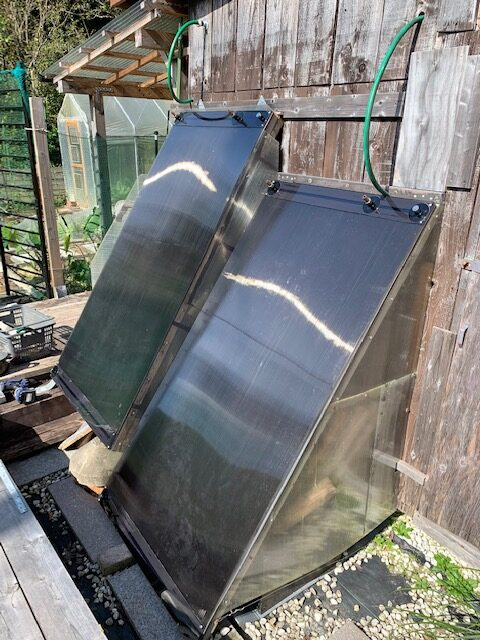
Figure 3. Example of Heatle Panels installed in a sunny garden instead of on a roof
Installation conditions must still be examined carefully, including solar exposure, wind loading, snow, overturning risk, collector support and piping distance.
The important point is to move beyond the assumption that every solar water heater must consist of a heavy tank mounted on a roof.
A Solar-Powered Pump That Naturally Responds to Sunlight
ESCOT directly connects a small photovoltaic panel to a DC high-temperature circulation pump.
As sunlight increases, the photovoltaic output rises and the pump starts operating. Stronger sunlight generally increases circulation. When sunlight becomes weaker, the flow rate decreases, and after sunset the pump stops.
This produces a simple form of natural coordination:
Stronger sunlight
↓
More photovoltaic output
↓
Increased circulation
↓
More heat transferred from the collectors to the bathtub
ESCOT currently uses a high-temperature circulation pump supplied by US Solar Pumps. Its S5 model can be connected to a small photovoltaic module of approximately 10 watts.
US Solar Pumps – S5 Solar Pump
The basic system can operate without grid electricity, an inverter or a timer. It can also operate during a power outage if adequate sunlight is available.
Care is still required to prevent circulation from causing net heat loss in weak late-afternoon sunlight. One possible passive adjustment is to orient the pump’s photovoltaic panel slightly eastward so that pump operation decreases earlier in the afternoon.
Designed to Be Maintained, Not Merely to Achieve Maximum Performance
ESCOT gives priority to long-term usability rather than competing only for the highest nominal performance.
The system is intended to:
- Use obtainable and replaceable components
- Allow users to identify the location of a fault
- Permit replacement of individual parts
- Allow the number of collectors to be adjusted
- Continue using an existing bathtub and water heater
- Operate during a power failure when sunlight is available
- Be understood, repaired and improved by its users
ESCOT’s Heatle Panel received an Energy Globe Award in 2016. However, receiving an international environmental award and achieving widespread social adoption are different challenges.
ESCOT will continue improving its DIY Heatle Panel while also examining the use of durable, commercially manufactured flat-plate collectors.
Our aim is to make solar thermal energy a technology that households and communities can adopt, maintain and improve—not a technology available only to specialists.
Developing a Practical Standard System with Commercial Collectors
One of the most difficult parts of a DIY solar thermal system is producing a collector that achieves both durability and reliable thermal performance.
ESCOT is therefore studying a hybrid approach:
- Use a reliable, commercially manufactured solar collector.
- Combine it with a small solar-powered circulation pump.
- Use simple and repairable piping.
- Transfer heat through a stainless-steel heat exchanger.
- Store the heat in an existing insulated bathtub.
ESCOT has contacted several Japanese manufacturers about purchasing only the collector component instead of a complete water-heating system. However, obtaining individual collectors in small quantities has so far been difficult.
We are therefore also contacting international manufacturers, including major Chinese solar thermal equipment companies, regarding:
- Trial purchase of one flat-plate collector of approximately 2 m²
- A quotation including transportation to Japan
- Technical specifications and performance-test reports
- Information on existing distributors in Japan
- The possibility of continued supply following a successful evaluation
The objective is not simply to import the lowest-cost overseas product.
The objective is to develop a practical system for Japanese homes based on:
A reliable solar collector
+
A photovoltaic-powered pump of approximately 10 watts
+
An existing insulated bathtub
+
Simple piping that can be maintained and repaired
Adaptation and Mitigation Must Be Pursued Together
Air conditioning, heatstroke prevention, improved insulation, solar shading and safer working practices will become increasingly important as extreme summer heat continues.
These measures protect people from climate impacts that are already occurring.
However, adaptation alone cannot stop climate change.
Measures that help people withstand heat must be implemented together with mitigation measures that reduce CO₂ emissions. Solar water heating may not appear as dramatic as a large power plant or a new generation of electronic technology, but it can steadily reduce the energy used for an everyday necessity: hot water.
Decarbonisation Cannot Be Achieved by Electricity Alone
Future climate policy must consider not only how electricity is generated, but also how necessary heat is produced.
Solar thermal systems can:
- Use solar heat directly
- Reduce gas, oil and electricity consumption
- Reduce both CO₂ emissions and energy costs
- Begin with a relatively small collector area
- Operate alongside photovoltaic systems and heat pumps
- Improve resilience during power outages and energy-price increases
- Be adapted for homes, facilities, agriculture and other low-temperature heat applications
NPO ESCOT is evaluating low-cost solar thermal configurations that use accessible flat-plate collectors and can work together with existing water-heating and heating equipment.
Solar thermal energy is not a technology of the past.
It is time to move beyond an electricity-only view of renewable energy and reconsider how hot-water, space-heating, drying and other thermal demands can be supplied directly by renewable heat.
Cooperation and Project Enquiries
NPO ESCOT welcomes contact from:
- Solar thermal collector manufacturers
- Japanese distributors and importers
- Pump and heat-exchanger manufacturers
- Housing and building-equipment companies
- Universities and research organizations
- Local governments and community-energy groups
- Organizations interested in field trials
- Households and facilities interested in practical solar thermal use
We are particularly interested in evaluating reliable flat-plate collectors and developing a simple, maintainable standard system suitable for use in Japan.