酷暑が海水温に及ぼす影響と湧昇効果
御宿の実測データで見る、海面から水深2mまでの鉛直水温変化
陸上で厳しい暑さが続くとき、海の中では何が起きているのでしょうか。
NPO法人エスコットでは、千葉県御宿で海面付近から水深2mまでの水温を継続観測しています。今回は、大気温度が特に高くなった日をモデル日として選び、気温の上昇に対して海面付近とその下の海水温が時間とともにどのように変化したかを調べます。
注目するのは、単に「海水温が高かったか」ではありません。
海面近くに熱がどの程度集中したのか、その熱が水深方向へどのように伝わったのか、そして夜になっても水温差が残ったのかを、実測データから確認します。
御宿での連続観測から見えてきた表層高水温と波動式湧昇ポンプ周辺の水温変化
NPO法人エスコットでは、千葉県御宿において、海面付近の水温を複数の水深で継続観測しています。
2026年7月から8月の実測データを解析したところ、海面からわずか2m程度の範囲でも、無視できない水温差が継続して存在していることが確認されました。
さらに、通常の水深0.3m地点と波動式湧昇ポンプ上部の水温を比較すると、ポンプ上部で継続的に低い水温が観測されるという興味深い結果も得られました。
今回の記事では、現時点で確認できている実測結果と、今後検証すべき点を分けて紹介します。
1.わずか2mの水深差で平均約1.8℃の水温差
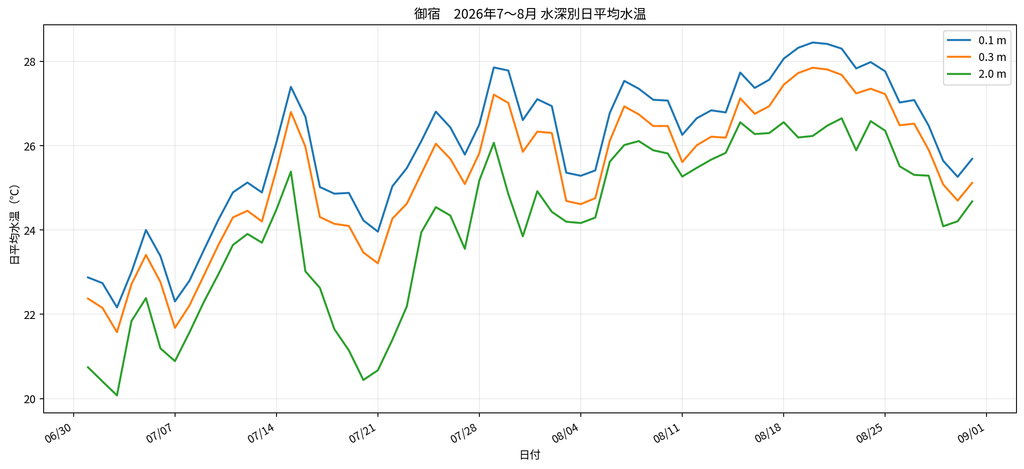
2026年7~8月の観測では、水深0.1m、水深0.3m、水深2.0mなどで水温を継続的に記録しました。
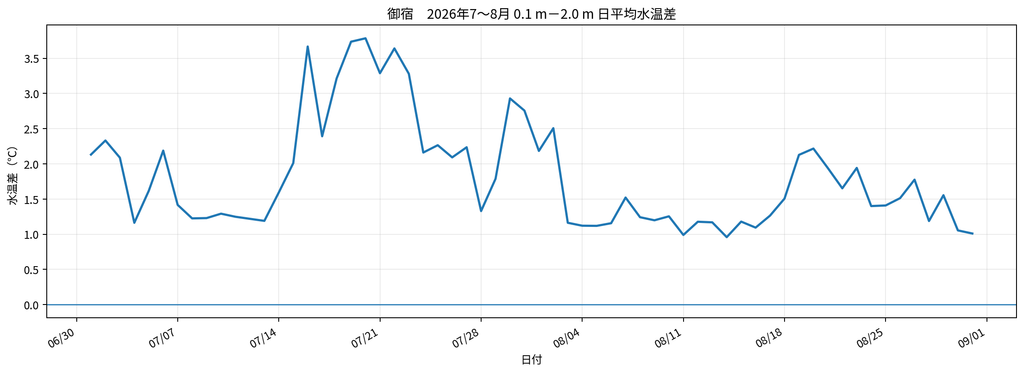
7~8月を通じて比較すると、水深0.1mと水深2.0mの水温差は平均で約1.8℃となりました。
月別では、
- 7月:約2.21℃
- 8月:約1.45℃
となっています。
また、日によっては水深0.1mと2.0mの日平均水温差が3℃を超えるケースも確認されています。
これは、海面からわずか2m程度の範囲でも、夏季には明確な鉛直水温差が形成され得ることを示す実測結果です。
2.「海水温」だけでは見えない海面付近の熱
一般に「海水温」というと、一つの温度で海の状態を表現しがちです。
しかし今回の観測では、0.1m、0.3m、2.0mという比較的小さな水深差でも異なる水温が観測されています。
特に夏季の日射が強い時期には、海面付近に熱が蓄積し、浅い層ほど高温になる状態が形成される可能性があります。
エスコットが注目しているのは、この「海面付近に蓄積した熱」です。
波動式湧昇ポンプについても、単に「深い場所の冷たい海水を汲み上げる装置」として考えるのではなく、表層とその下の水を波の力によって動かすことで、鉛直方向の水温構造や混合状態にどのような変化が生じるのかを調べる必要があります。
3.波動式湧昇ポンプ上部では低い水温を観測
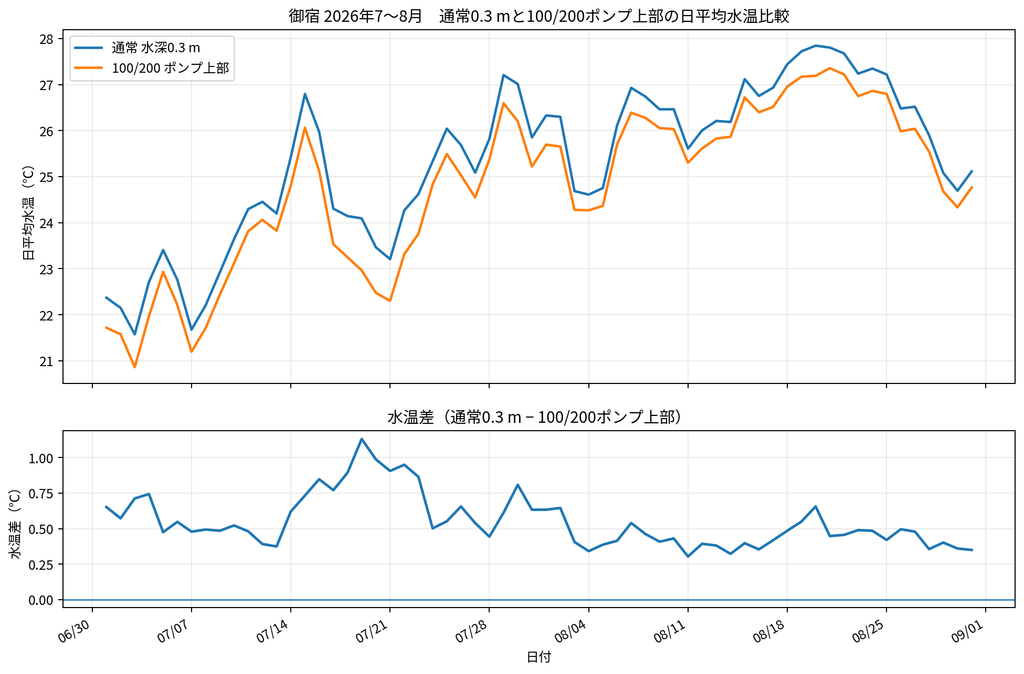
今回の観測では、通常の水深0.3mの水温と、100/200波動式湧昇ポンプ上部付近の水温についても比較しました。
7~8月の解析では、ポンプ上部の水温は通常の水深0.3mより平均で約0.55℃低い結果となりました。
また、比較可能な観測記録の大部分で、ポンプ上部が通常の0.3m地点より低温側となる傾向が確認されています。
これは、今回の観測で得られた重要な実測結果の一つです。
4.「0.55℃の冷却効果」とはまだ言えません
ここで重要な点があります。
ポンプ上部の水温が平均約0.55℃低かったからといって、
「波動式湧昇ポンプによって海水が0.55℃冷却された」
と現時点で結論づけることはできません。
水温には、波浪、流れ、潮汐、日射、風、センサーの位置や設置条件など、さまざまな要因が影響します。
したがって現段階で確認できているのは、
「波動式湧昇ポンプ上部で、通常の同程度の水深より低い水温が継続して観測された」
という事実です。
これがポンプによる鉛直方向の海水移動や混合によって生じたものなのかについては、さらに検証が必要です。
5.なぜ「わずかな水深での水温差」が重要なのか
今回の観測で特に注目しているのは、海面から2mという比較的浅い範囲に、これだけの水温差が存在したことです。
沿岸の高水温対策を考える場合、「沖合深層の非常に冷たい水を大量に汲み上げなければならない」とは限りません。
もし表層付近に高温の水が集中し、その直下により低温の水が存在するのであれば、その鉛直水温差と自然の波エネルギーをどのように利用できるかという別の視点が生まれます。
ただし、水温だけで導入効果を判断することはできません。
特に底層水を動かす場合には、溶存酸素(DO:水中に溶けている酸素)の状態を確認することが重要です。低酸素の水を無条件に表層へ移動させることが望ましいとは限らないためです。
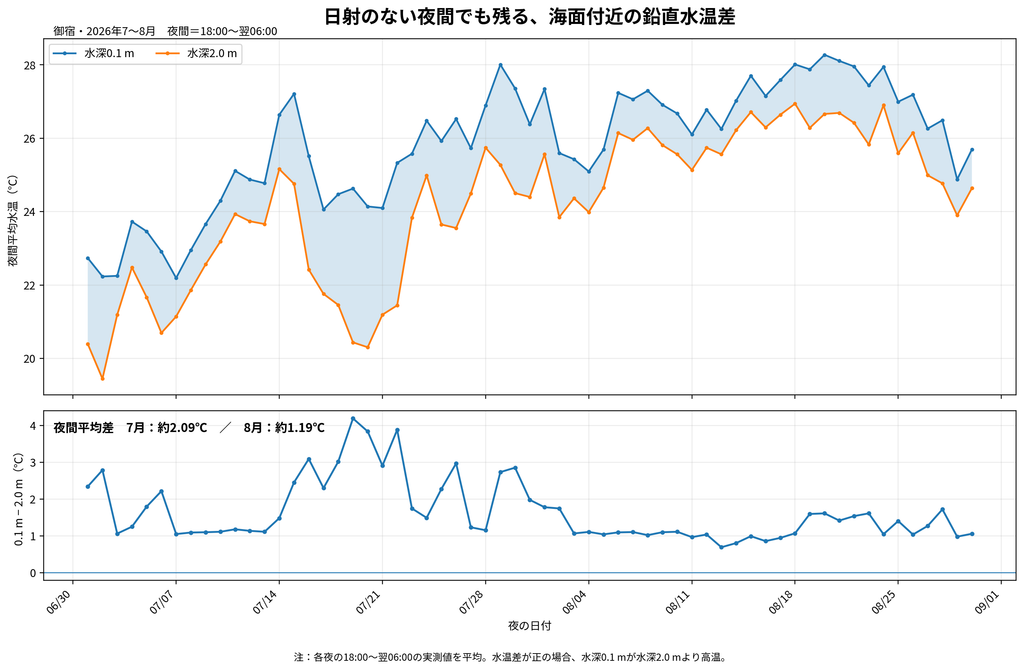
6.夜間にも残る水温差
今回の解析では、昼間だけでなく夜間にも水深による水温差が残る傾向が確認されています。
これは今後の研究で重要なポイントです。
通常、日射がなくなる夜間には表層水が冷え、風や波による混合も加わるため、水温差が小さくなることが考えられます。
それでも一定の水温差が残るのはなぜか。
波高、風速、潮汐、流況などのデータと水温データを時間軸で重ね合わせることで、海面付近の熱の蓄積と解消の仕組みをさらに詳しく調べる必要があります。
7.今後の検証
今回の結果は、波動式湧昇ポンプの効果を最終的に証明したものではありません。
一方で、
① 海面付近のわずかな水深差でも大きな水温差が存在すること
② 波動式湧昇ポンプ上部で周囲より低い水温が継続して観測されたこと
という二つの実測結果は、今後の検証につながる重要な手掛かりと考えています。
今後は、水温だけでなく、波高、風、潮汐、流況、溶存酸素(DO)などとの関係を調べ、波動式湧昇ポンプが沿岸の鉛直混合や高水温環境にどのような影響を与え得るのかを検証していきます。
実測データに基づく研究を続けます
近年、沿岸域の高水温は、養殖や漁業を含む海洋環境にとって重要な課題となっています。
エスコットでは、「冷たい水を汲み上げる」という一面的な考え方だけでなく、
海面付近に蓄積する熱を、自然の波エネルギーを利用してどのように分散・混合できるか
という視点から、波動式湧昇ポンプの可能性を研究しています。
今回の御宿での観測は、その検証を進めるための一つの実測データです。
今後も観測と解析を継続し、確認できた事実、データ解析から分かったこと、検証中の仮説を明確に区別しながら情報を公開していきます。
データについて
観測地点:千葉県御宿
解析対象期間:2026年7月~8月
主な観測水深:0.1m、0.3m、2.0m
比較対象:通常0.3m地点、100/200波動式湧昇ポンプ上部
※本記事に記載した水温差は御宿で得られた実測データの解析結果です。他の海域で同様の結果が得られることを保証するものではありません。ポンプによる水温変化の因果関係については検証を継続しています。
English Summary
Significant Water Temperature Differences Within Just 2 Meters of the Sea Surface
Continuous observations at Onjuku, Chiba, Japan reveal near-surface thermal stratification and an interesting temperature pattern around a wave-actuated upwelling pump
NPO ESCOT has been conducting continuous seawater temperature observations at several depths near the sea surface in Onjuku, Chiba Prefecture, Japan.
Analysis of measurements collected during July and August 2026 revealed a significant and persistent vertical temperature difference within only about two meters of the sea surface.
An additional comparison between ambient water at a depth of 0.3 m and water measured near the upper part of ESCOT’s wave-actuated upwelling pump showed another noteworthy pattern: temperatures near the pump were consistently lower.
These observations do not yet prove a causal cooling effect of the pump. However, they provide useful field data for investigating near-surface heat accumulation, vertical mixing, and the potential role of wave-driven water circulation.
1. An Average Temperature Difference of Approximately 1.8°C Within Just 2 Meters
During July and August 2026, seawater temperatures were continuously recorded at depths including 0.1 m, 0.3 m, and 2.0 m.
The average temperature difference between 0.1 m and 2.0 m was approximately 1.8°C over the two-month observation period.
The monthly average differences were:
- July: approximately 2.21°C
- August: approximately 1.45°C
On some days, the difference between the daily mean temperatures at 0.1 m and 2.0 m exceeded 3°C.
These field observations demonstrate that a distinct vertical temperature gradient can develop within a surprisingly shallow layer of coastal seawater during summer.
2. Heat Accumulation Near the Sea Surface
Sea surface temperature is often discussed as if the upper ocean could be represented by a single temperature.
Our observations indicate otherwise.
Even within the relatively small depth range of 0.1 m to 2.0 m, substantial temperature differences were observed.
Under strong summer solar radiation, heat can accumulate in the uppermost layer of the sea, potentially creating a warmer surface layer above cooler water.
This near-surface heat accumulation is one of the phenomena ESCOT is investigating.
Our wave-actuated upwelling pump should therefore not be viewed simply as a device for “pumping cold deep water upward.”
A broader research question is whether wave-driven vertical water movement can influence near-surface temperature structure, mixing, and heat distribution.
3. Lower Temperatures Observed Near the Wave-Actuated Upwelling Pump
We also compared the temperature at a normal monitoring point at approximately 0.3 m depth with the temperature measured near the upper part of a 100/200 wave-actuated upwelling pump.
During July and August, the temperature measured near the pump was, on average, approximately 0.55°C lower than at the normal 0.3 m monitoring point.
Lower temperatures near the pump were observed consistently throughout most of the comparable measurements.
This is an important observational result.
However, it must be interpreted carefully.
4. This Does Not Yet Mean a “0.55°C Cooling Effect”
The observed temperature difference does not by itself demonstrate that the wave-actuated upwelling pump cooled the surrounding seawater by 0.55°C.
Coastal water temperature is affected by many factors, including waves, currents, tides, solar radiation, wind, sensor position, and local installation conditions.
What has been confirmed from the measurements is:
Water near the upper part of the wave-actuated upwelling pump was consistently observed to be cooler than water at the normal monitoring point at a similar depth.
Further investigation is required to determine whether this difference was caused by wave-driven vertical water movement, enhanced mixing, local flow conditions, or a combination of factors.
5. Why Such a Large Temperature Difference at Shallow Depth Matters
One particularly important observation is that a substantial temperature difference existed within only about two meters of the sea surface.
When considering countermeasures against high coastal water temperatures, it may not always be necessary to assume that very cold water must be pumped from great depths.
If excessive heat is concentrated in a relatively thin surface layer while cooler water remains immediately below it, another approach may be possible: using the existing vertical temperature gradient together with natural wave energy to promote water movement and mixing.
Temperature alone, however, is not sufficient for evaluating environmental benefits.
Dissolved oxygen (DO) must also be considered, particularly when moving water upward from deeper layers. Bringing low-oxygen bottom water toward the surface without assessing local conditions could have undesirable ecological consequences.
6. Temperature Differences Persist Even at Night
Another notable result is that the vertical temperature difference did not disappear after sunset.
For our nighttime analysis, nighttime was defined as 18:00 to 06:00 the following morning.
The average nighttime temperature difference between 0.1 m and 2.0 m was approximately:
- July: 2.09°C
- August: 1.19°C
This means that the vertical temperature structure was not simply a short-lived daytime phenomenon caused by direct solar heating.
Why does a significant temperature difference remain even during the night?
This is an important subject for further study.
Future analysis will compare the temperature observations with wave height, wind speed, tides, currents, and other environmental data to better understand how heat accumulates and dissipates in the near-surface coastal layer.
7. Next Steps
The present observations do not constitute final proof of the environmental effects of the wave-actuated upwelling pump.
However, two field observations are particularly important:
1. Significant temperature differences can exist within only a few meters of the sea surface.
2. Water near the upper part of the wave-actuated upwelling pump was consistently cooler than water at a normal monitoring point at a similar depth.
These findings provide a basis for further investigation.
NPO ESCOT will continue examining relationships among water temperature, wave conditions, wind, tides, currents, dissolved oxygen (DO), and the operation of the wave-actuated upwelling pump.
Our objective is to better understand whether natural wave energy can be used to influence near-surface water circulation and help manage heat accumulation in coastal waters.
Research Based on Field Measurements
Rising coastal water temperatures are becoming an increasingly important issue for marine ecosystems, fisheries, and aquaculture.
ESCOT is investigating this challenge from a perspective that goes beyond simply “pumping cold water upward.”
Our research focuses on a broader question:
Can natural wave energy be used to redistribute or mix heat accumulated near the sea surface?
The Onjuku observations presented here are one step toward answering that question.
We will continue to publish our findings while clearly distinguishing between confirmed field observations, data-analysis results, technical interpretations, and hypotheses that still require verification.
Observation Data
Location: Onjuku, Chiba Prefecture, Japan
Analysis period: July–August 2026
Main measurement depths: 0.1 m, 0.3 m, and 2.0 m
Pump comparison: Ambient water at approximately 0.3 m depth vs. the upper section of a 100/200 wave-actuated upwelling pump
Note: The temperature differences reported here are based on field measurements obtained at Onjuku. They should not be assumed to occur under the same conditions at other coastal sites. The causal relationship between the operation of the wave-actuated upwelling pump and the observed temperature differences remains under investigation.
NPO ESCOT, Japan
Research on wave-actuated upwelling pumps, coastal thermal environments, and climate-risk adaptation.